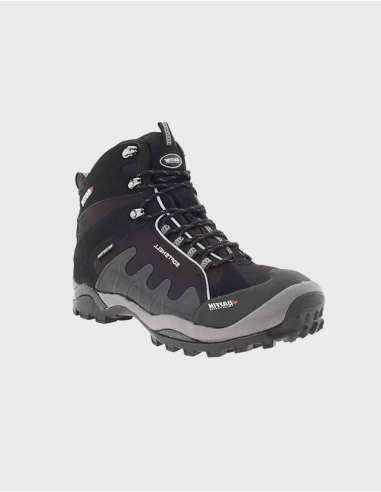
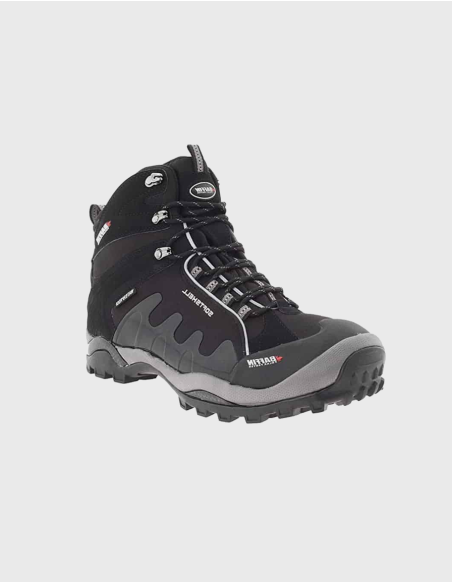
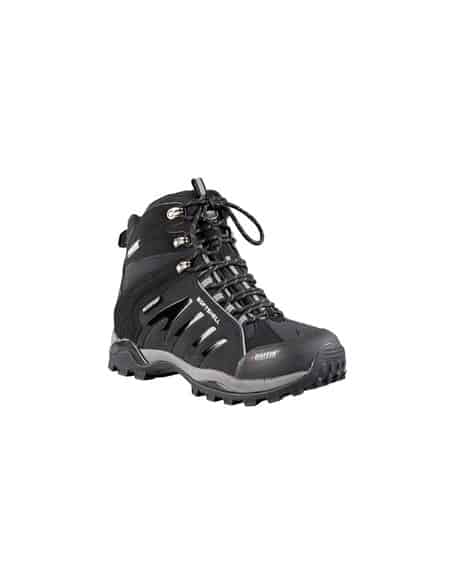
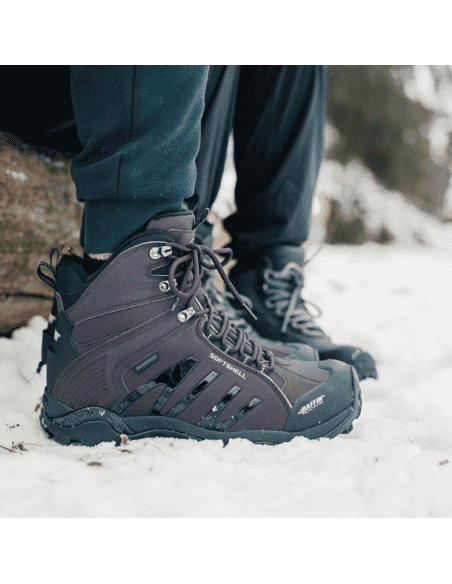
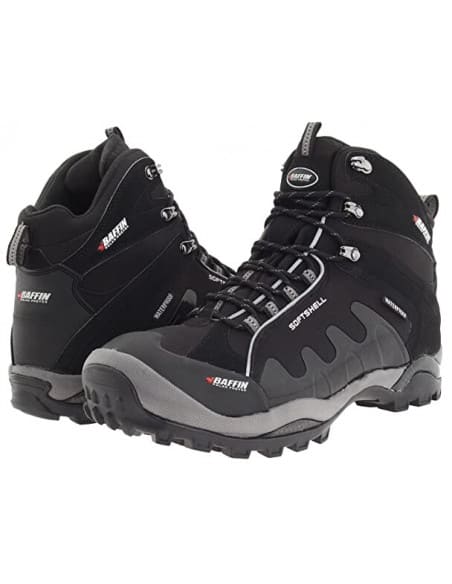
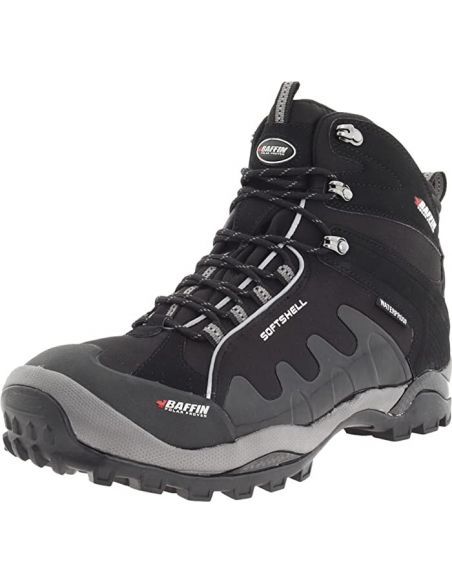
Men's Winter Hiking Boot Baffin Zone – Extreme Cold
Protection Extreme Cold
Shaft height 19.1 cm (7.5 in)
Insulation Built-in liner, 400 g equiv.
Protection temperature down to −30 °C / −22 °F*
Sizes EUR 39 to 48.5
Tendon guard and ledge Snowshoe binding compatible
The winter walking boot, for going far and going fast
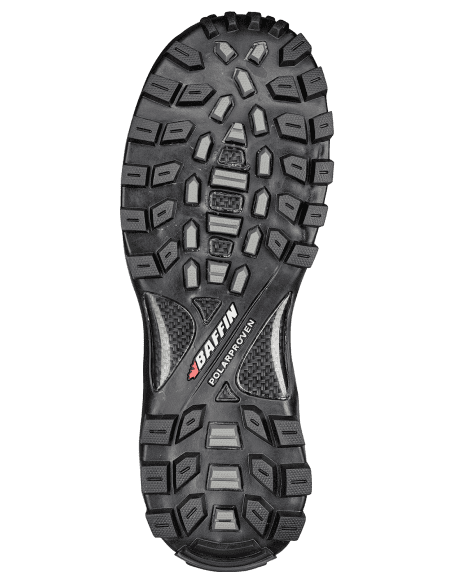
Protection given down to −30 °C / −22 °F*. At 1.99 kg (4.38 lb) a pair, the Zone sits a step below the brand's polar boots on weight, and that is the whole point of it. A breathable 19.1 cm (7.5 in) softshell upper, speed lacing, a rear pull loop. The base takes in a TPU plate that stops the sole twisting, a Polar Rubber™ outsole, an EVA midsole, and a tendon guard with a ledge shaped to take a snowshoe binding. Inside, a built-in Fixed-Fit liner with a waterproof breathable membrane, insulation comparable to 400 g. Tundra rated. EUR sizes 39 to 48.5, three colourways.
The Grand-Froid expert view
A polar boot and a winter walking boot are not chosen on the same criterion. The first is aimed at standing still in extreme cold; the second is aimed at hours of effort, and there every hundred grams is paid for in the calves over a four-hour outing. The Zone comes down on that side: 1.99 kg (4.38 lb), a supple upper that flexes at the ankle, a membrane that lets vapour out. One thing to know in return: the upper stops below the calf, and in deep snow a gaiter is still needed to keep snow from coming in over the top.
What is it for?
Built for high-intensity activity in sub-zero cold, on frozen or snow-covered ground.
- Snowshoeing: the use the base is drawn around — tendon guard, binding ledge, torsional rigidity
- Winter walking: frozen paths, packed snow, ascent over several hours
- Running and trail on snow: the model has been put through marathons and ultramarathons in the Arctic and Antarctic
- Fatbiking and winter sport: where the foot is working and breathability matters more than bulk
- Fast walking in hard cold: long journeys on foot, when weight counts as much as insulation
- Damp cold: the waterproof breathable membrane handles slush without trapping vapour
Thermal protection
Under effort, footwear has to solve two opposing problems: hold the heat in and let the vapour out. The Fixed-Fit liner is organised around that constraint — the Thermawick™ lining next to the foot clears perspiration and evens out temperature, the thermoformable B-Tek™ Foam moulds to the shape of the foot, and the four-channel hollow fibre B-Tek™ Heat builds volume of air while staying breathable, for insulation comparable to 400 g. The waterproof breathable membrane is made up as an inner bootie, which closes off water all the way round the foot. Added to that is a built-in frost plate under the foot, which returns heat and blocks the cold rising from the ground: that is the answer to conduction, the main route of heat loss the moment you stop. The Tundra rating places comfort at moderate to high activity across temperatures encountered from −10 °C to −30 °C (14 °F to −22 °F). The B-Tek™ Scent-Free lining keeps odours down on long outings. One point decides the outcome: the sock must never grip, because any compression crushes the air and removes the insulation.
Size guide
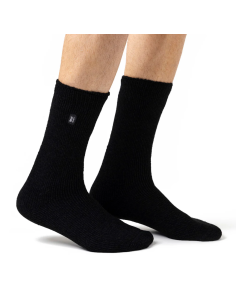
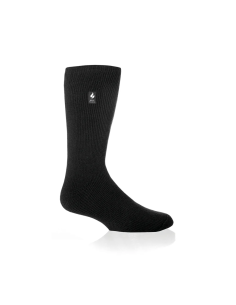
This model runs small: take the size above. The liner moulds to the foot after a few hours of wear. Wear a thick sock with no tightness.
| EUR |
US |
UK |
JP |
| 39 |
7 |
6 |
25 |
| 40.5 |
8 |
7 |
26 |
| 42 |
9 |
8 |
27 |
| 43 |
10 |
9 |
28 |
| 44.5 |
11 |
10 |
29 |
| 46 |
12 |
11 |
30 |
| 47 |
13 |
12 |
31 |
| 48.5 |
14 |
13 |
32 |
This model also comes in half sizes: EUR 41.25 · 42.5 · 43.75 · 45.25 (US 8.5, 9.5, 10.5, 11.5). EUR sizes 40, 41, 44 and 45 do not exist on this grid: those requirements move up to the size immediately above. Wear a thick sock with no tightness.
Technical features
- Mid-height breathable softshell upper, 19.1 cm (7.5 in) high in EUR 42
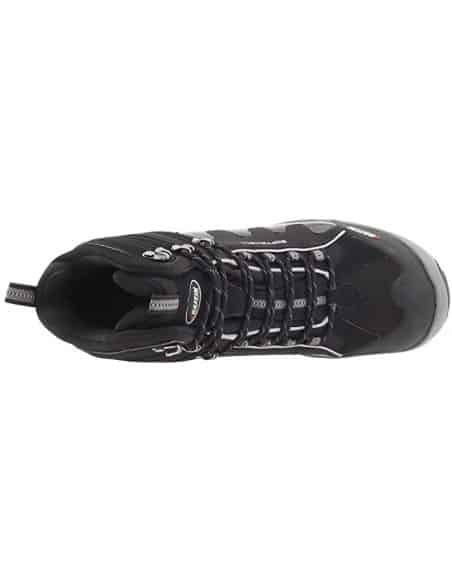
- Front speed-lace system: tightened in one pull, workable with gloves on
- Rear pull loop for easier entry
- Tendon guard and rear ledge: a stop for the strap of a snowshoe binding
- TPU plate: torsional rigidity when a step lands awkwardly
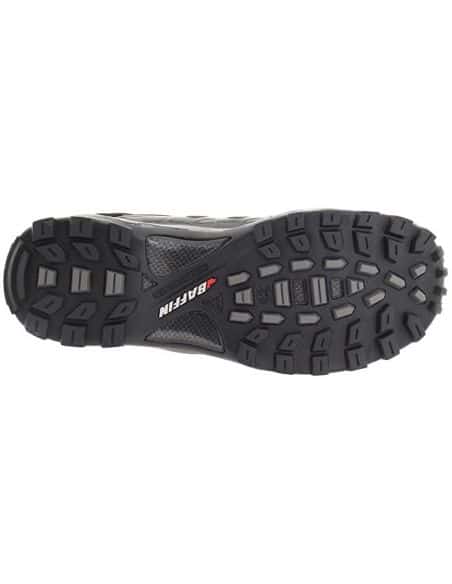
- Polar Rubber™ outsole: grip and longevity at low temperatures
- EVA midsole: lightweight insulation and cushioning
- B-Tek™ Dry waterproof breathable membrane, made up as an inner bootie
- B-Tek™ Scent-Free lining next to the foot
- Built-in multi-layer Fixed-Fit liner, insulation comparable to 400 g, with frost plate
- Vegan build, no materials of animal origin
- Weight 1.99 kg (4.38 lb) per pair in EUR 42, forefoot width 10.8 cm (4.25 in), outer length 30.5 cm (12 in)
- Sizes EUR 39 to 48.5, in black, brown or charcoal
Composition
⚠ [DATA MISSING] — The upper composition is contradictory at source: the technology sheet states softshell, the care instructions mention nubuck and cloth. Material split to be confirmed before publication.
- Upper: breathable softshell, with nubuck and textile sections
- Membrane: B-Tek™ Dry waterproof breathable, bootie construction
- Outsole unit: Polar Rubber™, EVA midsole, TPU plate
- Liner — inner layer: Thermawick™, moisture wicking and thermal regulation
- Liner — structure: thermoformable B-Tek™ Foam and four-channel hollow fibre B-Tek™ Heat
- Liner — reflection: built-in frost plate
- Next-to-foot lining: B-Tek™ Scent-Free
Care & Durability
- Nubuck: wipe with a damp cloth to remove excess dirt, then dry in open air
- Textile sections: hand wash in warm water, with a mild detergent for stubborn dirt
- Rubber base: wipe with a damp cloth
- Dry in open air, away from any direct heat source
- The liner is built in, so air the boot open after every long outing: that is the only way to clear the damp that has built up
- Store somewhere dry and ventilated, laces loosened
Return or exchange — 30 days
You have 30 days from delivery to request a return or an exchange on this item.
Why choose the Zone?
Because it is built around one use: walking and snowshoeing in hard cold, over long outings. The tendon guard and ledge hold the binding in place, the TPU plate steadies the foot on hard snow, the bootie membrane closes off water, and the frost plate blocks the cold rising from the ground. All of it at 1.99 kg (4.38 lb) a pair, which is the argument that decides things by the third hour.
A winter boot is judged at the end of the outing, not when you put it on
* Indicative temperature. Perceived warmth varies with activity, body type, humidity, wind, length of exposure and the socks worn.